.jpg) ADT vs. Brinks vs. Bay Alarm: Best Home Security in CA?">
ADT vs. Brinks vs. Bay Alarm: Best Home Security in CA?">
Every "best home security company" list online reads about the same because most of them are written by affiliates who have never installed a panel or answered a service call. This comparison is written from the perspective of a California-based ADT authorized dealer, so it is upfront about where ADT wins, where it does not, and what actually matters when you are choosing between the four providers homeowners in this state ask about most: ADT, Brinks, Bay Alarm, and SimpliSafe.
Quick Answer
For most California homeowners who want 24/7 professional monitoring, a national response network, and the widest choice of smart home integrations, ADT is the strongest overall pick, especially through a local authorized dealer who can tailor pricing and installation to your home. Brinks is a solid budget-friendly alternative with simpler equipment packages and shorter contracts. Bay Alarm is the right call if you specifically want a Northern California-based company with regional monitoring centers. SimpliSafe fits renters or anyone who wants a DIY, no-contract system, though it trades away professional installation and the deepest smart home integrations to get there.
How We're Comparing These Four
Before getting into each provider, here's the criteria this comparison actually weighs, so you can judge the ratings below against what matters to you specifically:
- Monitoring network reliability - how many redundant monitoring centers back up the signal, and how fast the average response time is
- Equipment ecosystem - how many device types (cameras, locks, thermostats, sensors) integrate natively
- Installation - professional vs. DIY, and what that means for setup accuracy and warranty coverage
- Contract structure - length, cancellation terms, and equipment ownership
- Local presence - whether you can get a technician to your door quickly, or only a call center
- Total cost - monthly monitoring plus equipment plus installation, not just the advertised headline number
Are Brinks and ADT the Same Company?
No, and this is one of the most common points of confusion, so it's worth settling first. Broadview Security, which was formerly Brink's Home Security, was acquired by ADT in 2010. If you have an old Brink's or Broadview panel in your home today, it is very likely running on ADT's monitoring network now. Current Brinks Home Security, marketed separately today, is a distinct company from ADT with its own monitoring infrastructure. If you are unsure which network your existing panel is on, see our guide on activating a Brink's or Broadview system.
ADT vs. Brinks: Head-to-Head
|
ADT |
Brinks |
|
|
Monitoring network |
Large national network of redundant monitoring centers |
Third-party monitoring network, single primary center |
|
Local dealer support |
Yes, through authorized dealers like California Security Pro |
Limited, mostly direct-to-consumer |
|
Equipment ecosystem |
Broad smart home integrations (locks, cameras, thermostats, video doorbells) |
Smaller, more curated equipment lineup |
|
Installation |
Professional installation standard |
DIY and professional options available |
|
Contract flexibility |
Varies by dealer and promotion, typically 24-36 months |
Typically shorter, 12-24 month options common |
|
Best for |
Homeowners who want the widest equipment options and local service |
Budget-conscious buyers who want simpler packages |
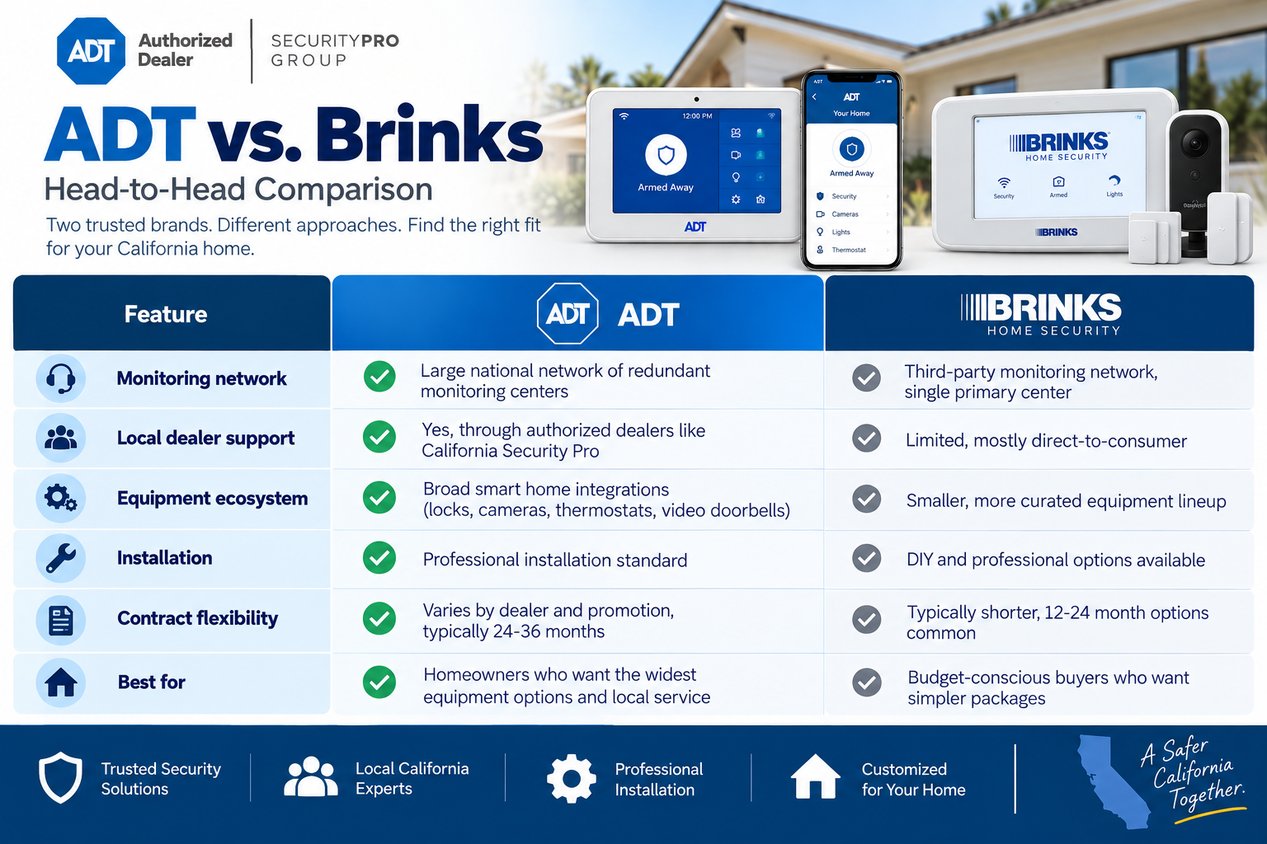
Where Brinks pulls ahead is contract flexibility and a more streamlined DIY setup for people who genuinely want to skip professional installation. Where ADT pulls ahead is the depth of the smart home ecosystem and the ability to pair national monitoring with local, same-week service through an authorized dealer rather than routing every issue through a call center.
ADT vs. Bay Alarm: Head-to-Head
Bay Alarm is a Northern California-headquartered company with a loyal regional following, particularly in the Bay Area, and it has been operating in the state for decades. Its strengths are local customer service, a regional monitoring center, and a reputation built on personal relationships rather than a national ad budget.
Where ADT tends to pull ahead is breadth of equipment options, national brand recognition (which matters if you sell your home and the buyer already has ADT elsewhere, since transferring service is simpler), and the ability to work with a local authorized dealer for California-specific pricing while still getting the reach of ADT's larger monitoring infrastructure. If Bay Alarm's monitoring center were ever to experience an outage or high call volume during a regional event like a wildfire evacuation, ADT's larger network of redundant centers provides an additional layer of backup that a single-region provider cannot match as easily.
ADT vs. SimpliSafe: Head-to-Head
SimpliSafe has built its brand around DIY installation, no long-term contracts, and a flat, transparent monthly price. It's a genuinely good fit for renters who cannot modify walls for wired sensors, or for anyone who wants to self-install and avoid a technician visit entirely.
The trade-off is real, though. SimpliSafe's equipment ecosystem is smaller than ADT's, professional installation is not the default (so setup accuracy depends entirely on the homeowner), and its monitoring, while solid, does not have the same decades-long track record or the density of local authorized dealer support that ADT has built across California. If something goes wrong with your DIY installation, and you're not confident diagnosing it yourself, you are largely on your own or waiting on a support call rather than a same-week local technician visit.
|
ADT |
SimpliSafe |
|
|
Installation |
Professional, technician-verified |
Self-install (DIY) |
|
Contract |
Typically 24-36 months through a dealer |
No long-term contract, month-to-month available |
|
Local service |
Yes, through local authorized dealers |
No, support-line based |
|
Best for |
Homeowners who want professional setup and local service |
Renters, apartments, or DIY-comfortable homeowners |
What Actually Matters When Comparing Providers
Most comparison articles stop at brand names. These are the factors that actually affect your day-to-day experience and your final cost:
- Response time and monitoring center redundancy. Ask each provider how many monitoring centers back up your alarm and what happens if one goes offline during a regional event.
- Equipment ownership. Some providers lease equipment, others sell it outright. This affects what happens if you cancel or move.
- Local installation and service. A national brand with no local dealer presence means longer wait times for service calls, sometimes weeks instead of days.
- Smart home compatibility. If you already use Alexa, Google Home, or specific smart locks, confirm compatibility before signing anything.
- Total cost, not just the advertised monthly rate. See our complete ADT cost breakdown for how to get an apples-to-apples number across providers.
- What happens at cancellation. Ask specifically whether equipment stays with you, gets deactivated remotely, or needs to be returned, and whether there's an early termination fee.
Why Local Dealer Support Changes the Comparison
A national provider's monitoring quality is the same whether you buy direct or through a dealer, since the alarm signal goes to the same monitoring centers either way. What changes is everything around that signal: installation quality, response time for service calls, and whether pricing is generic or tailored to your home. This is the core argument for going with a local ADT authorized dealer over a national call center or a DIY-only provider, which we cover in full detail in Is a Local ADT Authorized Dealer Better Than Going Direct?
Bottom Line by Household Type
- Homeowner who wants the broadest equipment ecosystem and fast local service: ADT through a California authorized dealer
- Budget-conscious buyer who wants a simpler package and shorter contract: Brinks
- Someone who specifically wants a Northern California regional company: Bay Alarm
- Renter or DIY-comfortable buyer who wants no contract: SimpliSafe
Frequently Asked Questions
Is ADT worth the price compared to cheaper alternatives? For most households, yes, because of the combination of monitoring reliability, equipment selection, and local service availability. See our full cost breakdown to compare the real numbers against Brinks and other providers.
Can I switch from Brinks or Bay Alarm to ADT without losing my existing equipment? Often some existing wiring and sensors can be reused, which lowers your installation cost. Our guide on upgrading your existing security system to ADT explains what typically transfers.
Is a DIY system like SimpliSafe actually less secure than a professionally installed system? Not inherently, but installation accuracy matters a lot for sensor placement and coverage gaps, which is where professional installation has a real edge for larger or more complex homes.
How long are typical ADT contracts through a local dealer? This varies by dealer and current promotion, so ask for the exact term length and cancellation terms in writing before signing.
Do all these providers use the same type of monitoring centers? No. Center count, redundancy, and certification (such as UL-listed status) vary by provider, and it's a fair question to ask directly during any consultation.
What happens to my equipment if I cancel service? This depends on whether equipment was purchased outright or leased. Ask this question before signing with any provider, not after.
Can I have cameras from one brand and a panel from another? Some systems support third-party camera integration, but for guaranteed compatibility and warranty coverage, using a single ecosystem's equipment is generally simpler and more reliable.
Talk to a Local Expert Before You Decide
Reading comparisons online only gets you so far. Contact us for a straightforward, no-pressure walkthrough of what each option would actually look like and cost for your specific home.